Faucet and Sink Repair in Grand Rapids: The Complete Guide
Faucet and sink repair is the plumbing work that stops drips, restores flow and seals the supply and drain connections of kitchen, bathroom, laundry and commercial sinks. It belongs to fixture repair, the part of residential and commercial plumbing that sits between the building's supply pipes and its drain lines. In Grand Rapids, Michigan, the work centers on five entities: the faucet, the faucet cartridge or washer that seals it, the fixture shutoff valve, the sink supply line and the sink drain assembly with its P-trap. Hard Lake Michigan water and the 2021 Michigan Plumbing Code shape how each part fails and how it gets replaced. Faucet and sink repair in the Grand Rapids area ends where a clogged drain line or a hidden leak inside a wall begins.
Faucet Types and Valve Mechanisms
Faucet types decide which part wears out and which repair stops a leaky faucet. Every faucet controls water with one of four valve mechanisms, and commercial settings add a fifth design:
| Faucet type | Handles | Wear part | Typical failure |
|---|---|---|---|
| Compression | Two | Rubber washer and valve seat | Drip from the spout; handle closes harder over time |
| Ball | One | Rotating ball, seats and springs | Drip from the spout; leak around the handle |
| Cartridge | One or two | Cartridge and O-rings | Drip, stiff handle, leak at the base |
| Ceramic disc | One | Disc seals | Drip or leak at the base when seals wear |
| Metering (public restrooms) | Push button | Timing cartridge | Runs too long or shuts off too soon |
Compression faucets press a rubber washer against a brass seat, and the City of Grand Rapids names a bad rubber washer as the usual cause of a leaking faucet. Older housing keeps these two-handle designs in service: the U.S. Census Bureau's American Community Survey (2020–2024) puts 37.5% of Grand Rapids homes before 1940 and the median home at 1953. Single-handle cartridge and ceramic disc faucets fill most newer kitchens and vanities.
Setting changes the rules. The 2021 Michigan Plumbing Code holds a public lavatory faucet to 0.5 gallon per minute and a metering faucet to 0.25 gallon per cycle, while a home kitchen sink faucet runs up to 2.2 gallons per minute. Every new faucet conforms to ASME A112.18.1/CSA B125.1, and faucets that deliver drinking water also meet NSF 61, Section 9 (§412.1).
Faucet and Sink Failure Points
Faucet and sink failure points fall into supply-side leaks, which run whenever the water is on, and drain-side leaks, which run only while the sink drains. Five failure points account for most kitchen sink repair and bathroom sink calls:
- Spout drip — a worn washer, seat, cartridge, ball seal or disc seal lets water past the closed valve.
- Base and handle leak — failed O-rings let water escape around the spout or handle and run down to the counter or into the cabinet.
- Aerator restriction — mineral scale and debris narrow the aerator screen and cause low water pressure at the faucet.
- Supply connection leak — a weeping compression nut, an aged supply line or a leaking angle stop stem drips constantly inside the cabinet.
- Drain and trap leak — a loose slip nut, cracked P-trap or failed basket strainer seal drips only while water drains.
The City of Grand Rapids directs owners to check faucets at three places: the faucet head, the base and the connections. That sequence separates a drip that wastes water into the basin from a seep that soaks a cabinet floor.
Water pressure adds stress to every supply-side part. Section 604.8 of the 2021 Michigan Plumbing Code calls for a pressure-reducing valve where static pressure inside a building exceeds 80 psi. Weak flow at every fixture, instead of one, points away from the sink and toward the supply line, a case that leak detection covers.
Grand Rapids Water Hardness and Faucet Scale
Grand Rapids water hardness explains why aerators clog, cartridges stiffen and white crust forms at the spout. The City of Grand Rapids' 2025 Average Water Analysis measured total hardness at 142 mg/L (8.3 grains per gallon) at the plant tap, against 143 mg/L (8.4 grains per gallon) in raw Lake Michigan water. The U.S. Geological Survey (USGS) classes 121–180 mg/L as hard, so Grand Rapids tap water sits in the hard band despite its Lake Michigan source.
Hardness changes across the metro, because suburbs draw on different suppliers:
| Area | Water supply | Hardness | USGS class |
|---|---|---|---|
| Grand Rapids | Grand Rapids Water System, Lake Michigan | 142 mg/L (8.3 gpg) | Hard |
| Grandville | City of Wyoming, Lake Michigan | 97 ppm | Moderately hard |
| Jenison (Georgetown Township) | City of Wyoming, Lake Michigan | 89–108 ppm, average ~99 | Moderately hard |
| Hudsonville | City of Wyoming, Lake Michigan | 91.1–118.8 ppm, average 98.78 | Moderately hard |
| Caledonia Township (south well district) | Township wells; the north district switched to Grand Rapids water March 10, 2026 | 22–30 grains per gallon | Very hard |
Sources: City of Grand Rapids 2025 Average Water Analysis; City of Grandville, Georgetown Township and City of Hudsonville 2025 water reports; Caledonia Township Water Changeover Q&A (October 2025); USGS hardness classes.
The USGS links hard water to mineral buildup in plumbing and fixtures and to scale that narrows pipes and lowers water pressure. At a faucet, that buildup collects first in the aerator screen and around cartridge O-rings. Grand Rapids-area plumbing pages report the same pattern: Grand Rapids hard water stiffens handles and clogs aerators. A faucet on Wyoming-supplied water in Grandville scales more slowly than one on Grand Rapids water, and a faucet on unsoftened Caledonia well water scales faster than either.
Under-Sink Plumbing Components
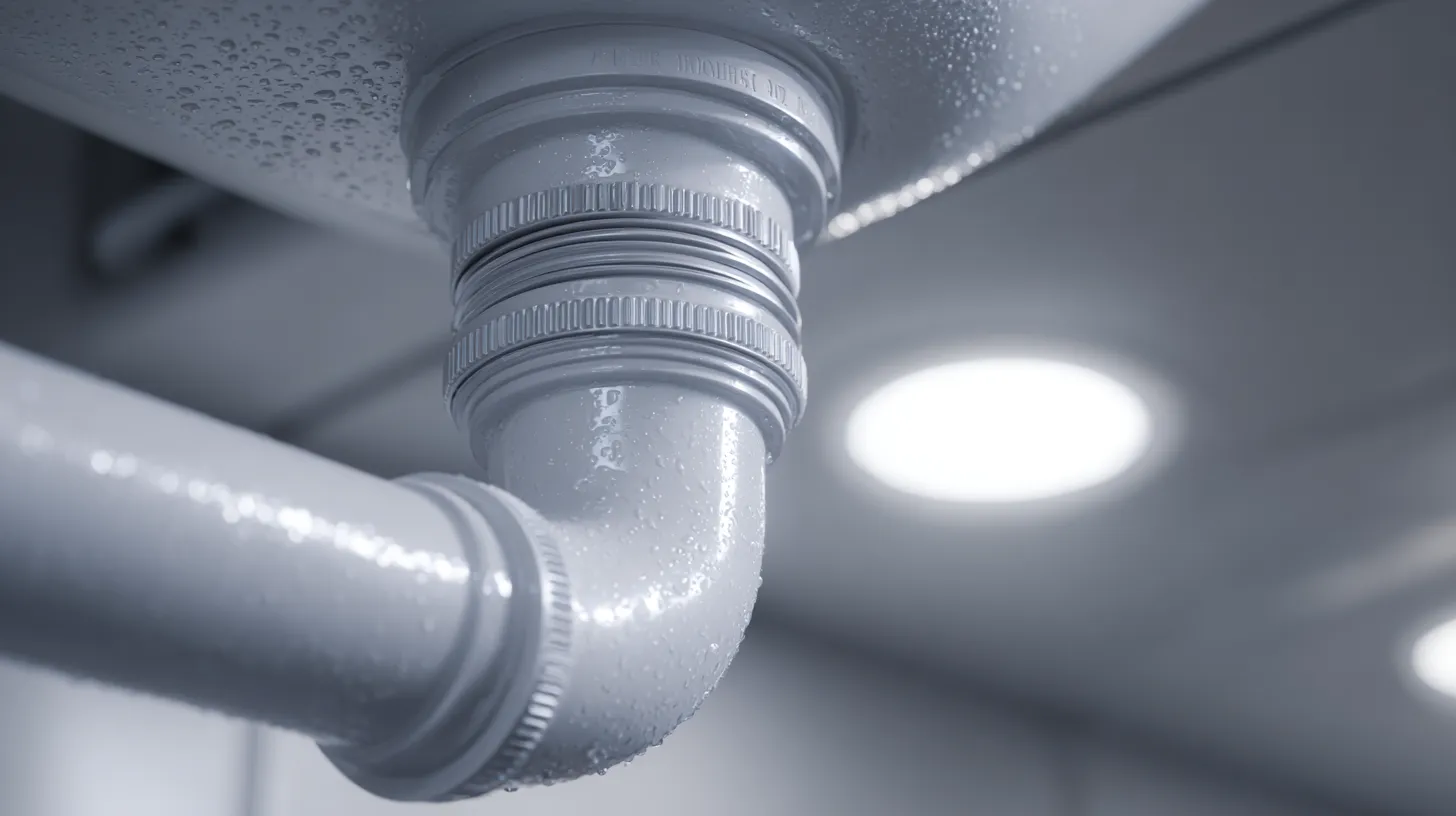
Under-sink plumbing components connect the faucet to the supply pipes and the basin to the drain, and each joint marks a possible source of water under the sink. Five components sit inside a typical sink cabinet:
- Angle stop valve — the quarter-turn or multi-turn valve on each hot and cold supply. Section 606.2 of the 2021 Michigan Plumbing Code requires a shutoff on the supply to every fixture other than bathtubs and showers.
- Supply line — braided stainless steel or rigid tubing that runs from the angle stop to the faucet tailpiece, joined by a compression nut and ferrule.
- Tailpiece — the straight drain section below the basin outlet; Section 422.2 sets a sink's waste outlet at 1½ inches minimum, and Section 419.3 sets a lavatory's at 1¼ inches.
- P-trap — the curved section that holds a water seal of 2 to 4 inches against sewer gas, the same trap the drain cleaning work clears when it clogs.
- Basket strainer or pop-up drain — the drain fitting set in the basin; Section 422.2 requires a strainer or crossbar on a sink outlet, and Section 419.3 allows a strainer, pop-up stopper or crossbar on a lavatory.
Section 607.4 adds a layout rule: hot water flows from the left-hand side of the fixture fitting. Section 405.6 requires the joint where a fixture meets a wall or floor to be sealed, which keeps splash water out of the cabinet and wall cavity.
Repair and Replacement Methods
Repair and replacement methods follow the failure point, and most leaky faucet repair replaces one small part. Five methods cover nearly every faucet and sink repair:
- Washer and seat replacement — a new rubber washer, and a dressed or replaced seat, ends a compression faucet drip.
- Cartridge replacement — a model-matched cartridge and new O-rings end drips and stiff handles in single-handle faucets.
- Aerator cleaning — unscrewing the aerator, soaking out scale and rinsing the screen restores flow; EPA WaterSense notes that a replacement aerator costs as little as a few dollars.
- Supply line and angle stop replacement — new valves and supply lines end constant cabinet leaks and give the sink a working shutoff.
- Faucet and sink replacement — a new faucet, or a new basin with its faucet and drain assembly, replaces corroded bodies, cracked basins and repeated failures.
Cost follows scope. A 2026 Michigan plumbing cost guide (askdoss, updated August 2026) and This Old House's 2026 Plumbing Cost Guide list these ranges:
| Job | Typical cost | Source |
|---|---|---|
| Faucet replacement, professional | $200–$500 (average $300, 1–2 hours) | askdoss 2026 |
| Faucet replacement, DIY parts | $50–$200 | askdoss 2026 |
| Faucet replacement, national | $150–$600 | This Old House 2026 |
| Shutoff valve installed, professional | $150–$300 | askdoss 2026 |
| Leaking pipes | $150–$450 | This Old House 2026 |
| Sink installation | $200–$800 | This Old House 2026 |
| Grand Rapids service call | $65–$100 | askdoss 2026 |
| Grand Rapids hourly rate | $90–$130 | askdoss 2026 |
The same Michigan guide puts the average Grand Rapids plumbing repair at $300 to $450. Grand Rapids-area plumbing pages describe most faucet repairs as 30-minute to 2-hour jobs. Garbage disposal repair and replacement form a separate service with their own cost range.
The 2021 Michigan Plumbing Code Caps Sink and Private Lavatory Faucets at 2.2 Gallons per Minute at 60 PSI
Table 604.4 of the 2021 Michigan Plumbing Code limits a kitchen sink faucet and a private bathroom lavatory faucet to 2.2 gallons per minute at a test pressure of 60 psi. Public lavatories drop to 0.5 gpm, and metering faucets to 0.25 gallon per cycle. The aerator does much of that limiting work, so a faucet that loses its aerator, or carries a scaled one, no longer flows as designed. EPA WaterSense sets a lower voluntary mark for bathroom faucets and aerators: 1.5 gpm maximum, a cut of 30% or more from the 2.2 gpm standard, and its draft Version 2.0 proposes 1.2 gpm. The code sets the ceiling; WaterSense sets a target below it.
Michigan's Plumbing Code Requires a Shutoff Valve on the Supply to Every Fixture Except Bathtubs and Showers
Section 606.2 of the 2021 Michigan Plumbing Code requires a shutoff valve on the fixture supply to each plumbing fixture other than bathtubs and showers, along with shutoffs for sillcocks and appliances. Under a sink, those valves are the two angle stops. A working angle stop isolates one sink, so a cartridge or supply line gets replaced while the rest of the building keeps water. A sink without stops, or with stops frozen open after years without use, forces a whole-building shutoff at the main valve next to the meter, where Grand Rapids requires a valve on each side. A 2026 Michigan cost guide puts a professionally installed shutoff valve at $150 to $300.
A Faucet Dripping Once per Second Wastes More Than 3,000 Gallons a Year
EPA WaterSense puts a faucet dripping once per second at more than 3,000 gallons a year, the water needed for more than 180 showers. Household leaks of all kinds waste more than 9,300 gallons a year in the average home, and fixing easily corrected leaks saves about 10% on water bills. A dripping faucet sits among the easily corrected leaks, because a washer, cartridge or seal ends it. The meter tests and toilet checks that find hidden leaks belong to leak detection; a faucet drip announces itself at the spout.
Federal Law Defines a Lead-Free Faucet as No More Than 0.25% Lead Across Its Wetted Surfaces
The Reduction of Lead in Drinking Water Act, passed by Congress in 2011, defines lead-free pipes, fittings and fixtures as a weighted average of 0.25% lead across the wetted surfaces, and lead-free solder and flux as 0.2% lead, according to the EPA. The 2021 Michigan Plumbing Code separately requires faucets that deliver drinking water to meet NSF 61, Section 9. A new kitchen or lavatory faucet therefore carries both a federal lead-free definition and a drinking-water standard. Faucets built before the 2011 definition carry no assurance of meeting it, which adds a health factor to the repair-or-replace decision on an older brass faucet.
Michigan's Plumbing Code Exempts Repairing Leaks in Pipes, Valves and Fixtures From Permits
Section 106.2 of the 2021 Michigan Plumbing Code exempts two kinds of work from permits: stopping leaks in drain, water, soil, waste or vent pipe, and clearing stoppages or repairing leaks in pipes, valves or fixtures. A new washer, cartridge, O-ring or aerator therefore needs no permit. The exemption has limits. Replacing a concealed trap or drain pipe with new material counts as new work, and replacing or rearranging valves, pipes or fixtures falls outside the listed repairs. In Grand Rapids, the city's Development Center issues plumbing permits and confirms which replacement work needs one. The exemption also grants no permission for work that violates the code.

Frequently Asked Questions
Why Does A Faucet Drip After The Handle Is Closed?
A worn sealing part lets water slip past the closed valve. In two-handle compression faucets, the rubber washer or seat wears, and the City of Grand Rapids names a bad rubber washer as the usual cause. Single-handle faucets drip when the cartridge, ball seals or disc seals wear.
What Causes Water Under A Kitchen Sink?
Five sources put water in a sink cabinet: a supply line or its compression nut, a leaking angle stop, a seep at the faucet base, a loose slip nut or cracked P-trap, and a basket strainer that lost its seal. Supply-side leaks run constantly; drain-side leaks appear only while the sink drains.
Why Does One Faucet Lose Pressure While The Rest Of The House Runs Normally?
A restriction inside that one faucet causes it. Scale or debris in the aerator screen or cartridge narrows the flow path, and the USGS links hard water to mineral buildup in fixtures. Grand Rapids water tests hard at 142 mg/L. Low pressure at every fixture points to the supply line instead.
Which Side Of A Faucet Supplies Hot Water?
The left side. Section 607.4 of the 2021 Michigan Plumbing Code requires hot water to flow from the left-hand side of the fixture fitting, with an exception for shower and tub mixing valves marked otherwise. Hot and cold lines reversed under a sink break that rule.
How Much Water Does A WaterSense Bathroom Faucet Save?
EPA WaterSense puts the savings at about 700 gallons a year for the average family and nearly 11,000 gallons over the faucet's life. WaterSense bathroom faucets and aerators flow at no more than 1.5 gallons per minute, against a 2.2 gpm standard.
Common Misconceptions About Faucet and Sink Repair
Misconception: Tightening The Handle Harder Stops A Faucet Drip
Extra force presses a worn washer or seal harder for a moment while the wear behind the drip stays in place. Overtightening crushes washers, scores valve seats and strips cartridge stems, which turns a washer repair into a valve repair. A new washer, seat or cartridge stops the drip.
Misconception: Any Replacement Cartridge Fits Any Single-Handle Faucet
Cartridges differ in length, spline pattern, stem shape and seal layout between manufacturers and models. A mismatched cartridge leaks, binds or fails to seat in the faucet body. Matching the cartridge to the faucet model, or carrying the old cartridge to the supply house, settles the fit.
Misconception: Water Under A Sink Always Comes From The Faucet
The faucet accounts for one of five sources in the cabinet. Supply lines, angle stops, drain slip nuts and basket strainers each leak into the same space. Running water with the drain plugged and then open separates a supply-side leak, which runs either way, from a drain-side leak, which appears only while water drains.
Misconception: Low Pressure At One Faucet Means The City Water Pressure Dropped
A citywide or service-line problem lowers pressure at every fixture, and the City of Grand Rapids lists a pressure drop across the building as a sign of an underground leak. Weak flow at a single faucet comes from that faucet's aerator, cartridge or supply line. Cleaning the aerator answers the question in minutes.
Misconception: An Older Brass Faucet Meets The Current Lead-Free Standard
Congress set the current lead-free definition in the Reduction of Lead in Drinking Water Act in 2011: a weighted average of 0.25% lead across wetted surfaces. A faucet made before that definition carries no assurance of meeting it. A replacement faucet that meets NSF 61, Section 9, as the 2021 Michigan Plumbing Code requires for drinking-water faucets, closes the question.
Ongoing Debates in Faucet and Sink Repair
Repair and replacement divide owners of aging faucets. A cartridge or washer costs little and keeps a familiar faucet in service. Replacement, at $200 to $500 installed in a 2026 Michigan cost guide, ends repeated repairs and brings a lead-free, code-flow fixture. Grand Rapids-area plumbing pages publish a rule of thumb that favors repair on faucets under about 10 years old with a single worn part. Body corrosion and parts availability settle most cases.

Water softeners and routine aerator cleaning divide hard-water strategies. A softener removes the calcium and magnesium that form scale at every fixture in a Grand Rapids home at 142 mg/L. Aerator cleaning handles the same scale at one faucet for a few minutes of work and no equipment. The number of fixtures affected and the water heater's needs tip the choice.
Owner repairs and plumber repairs divide the work itself. The City of Grand Rapids treats a worn rubber washer as a common, low-cost faucet fix and points owners who prefer not to make repairs themselves to a licensed plumber. Washers and aerators suit owner repair; angle stops frozen with corrosion and compression nuts on old supply pipe break when disturbed and turn a sink repair into a pipe repair.
Low-flow and full-flow faucets divide kitchens and bathrooms. WaterSense bathroom faucets at 1.5 gpm save about 700 gallons a year per family, and EPA's draft Version 2.0 proposes 1.2 gpm. Users who fill pots, buckets and basins prefer the full 2.2 gpm code maximum at the kitchen sink, where filling time matters more than flow.
Braided stainless supply lines and rigid supply tubing divide installers. Braided lines install in minutes, flex to fit any faucet and absorb movement. Rigid tubing carries no rubber core inside a braid, but it takes bending and cutting to fit. Access inside the cabinet and the installer's practice decide which one goes in.
Components of a Grand Rapids Faucet and Sink Repair
Every faucet and sink repair works through the same five components. The cartridge is a component of a single-handle faucet valve; it mixes hot and cold water and shuts off flow, and its O-rings collect the first scale in hard Grand Rapids water. The aerator is a component of the faucet spout; it shapes the stream and limits flow toward the code's 2.2 gpm ceiling, and a scaled screen produces low water pressure at the faucet. The compression nut and ferrule are components of the angle stop connection; they squeeze the supply line onto the valve outlet, and a nut that loosens or corrodes produces water under the sink around the clock. The P-trap is a component of the sink drain assembly; it holds a 2-to-4-inch water seal against sewer gas, and its slip nuts leak only while the sink drains. The basket strainer is a component of the kitchen sink drain opening; its gasket and locknut seal the basin to the drain, and a failed seal drips when the basin holds water. A plumber identifies which component failed before choosing between a part repair, a new supply connection and a faucet replacement.
Summary
Faucet and sink repair in Grand Rapids covers five areas: faucet types, failure points, local water hardness, under-sink components and repair methods. Grand Rapids tap water tests hard at 142 mg/L, which scales aerators and cartridges, while the 2021 Michigan Plumbing Code caps sink faucets at 2.2 gpm, requires a shutoff on every sink supply and exempts leak repairs from permits. A faucet dripping once per second wastes more than 3,000 gallons a year. Faucet and sink repair in the Grand Rapids area starts at the failed part and ends with a dry cabinet and full flow at the spout.